
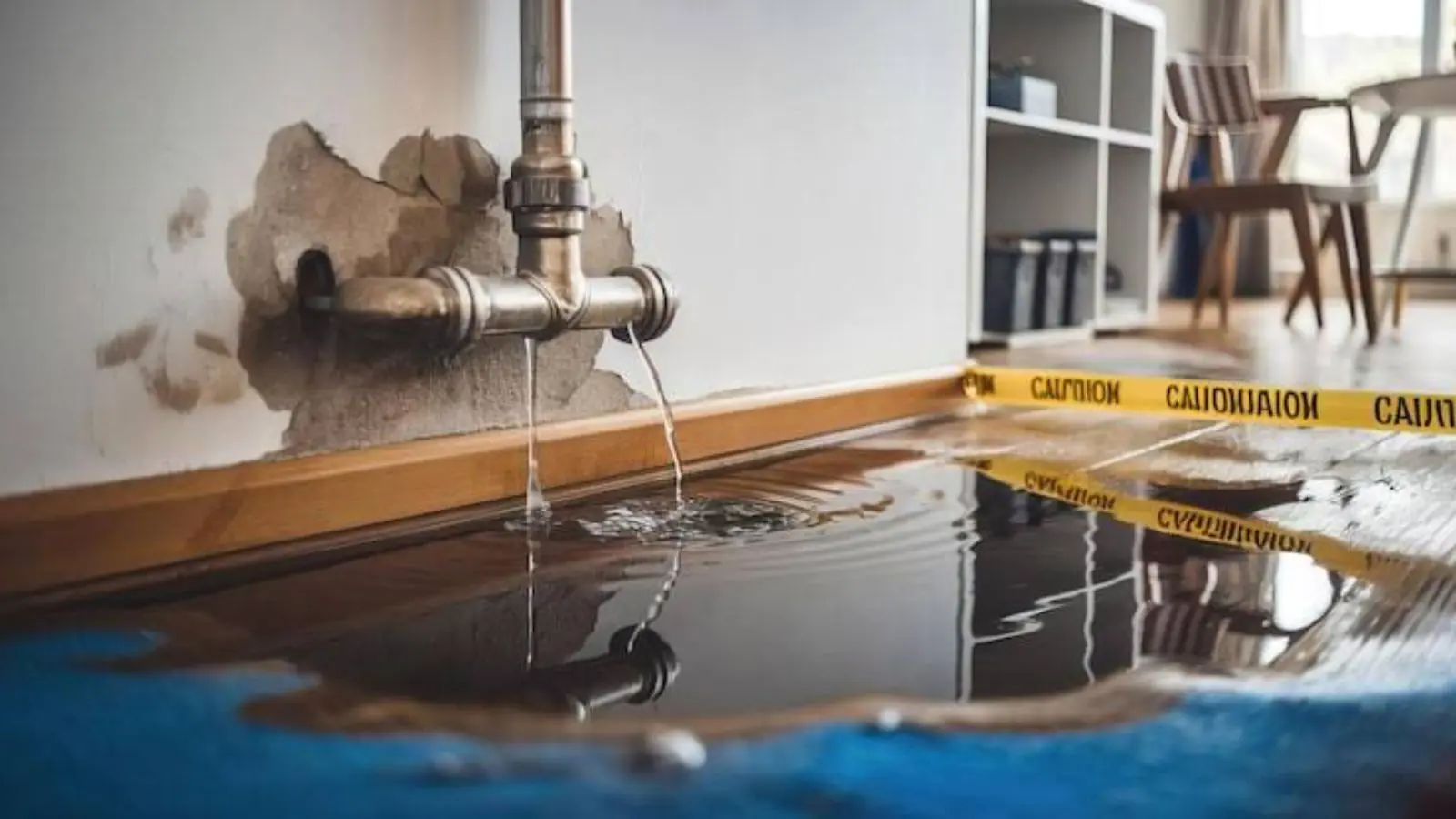
When a supply line splits, cracks or pulls apart at a joint, pressurized water pours into the wall, ceiling or floor until someone closes the valve. Closing the main stops the flow, and everything after that is about limiting what the water already reached.
Our dispatch line answers 24/7. Shut off the water first, then call, and use the steps below while the crew is on the way. Skip the mop until the photos are taken, and do not wait to see whether the leak slows down.
The first-hour sequence
Do these in order. Each one takes a few minutes at most.
Close the main shutoff
Turn the valve clockwise until it stops. A lever handle closes when it sits crosswise to the pipe.
Check the electrical risk
If water is near outlets, a ceiling light fixture or the panel, do not touch them. Flip the main breaker only if a dry panel and dry footing let you reach it safely.
Drain the lines
Open the lowest faucet in the house and the highest one, then flush toilets once. This lowers the pressure left in the pipes.
Turn off the water heater
Switch off its breaker or set the gas control to pilot before draining, so the heater does not run dry.
Photograph everything
Record the broken section, wet walls, ceilings, floors and furniture before moving anything.
Lift and move
Pull rugs, books, papers and electronics out of the water. Put foil or blocks under furniture legs.
Call for extraction and drying
Standing water and wet walls need pumps, air movers and dehumidifiers, which is what emergency water removal crews bring.
Finding the main shutoff before you need it
Most homes have a main shutoff near where the line enters, often on an outside wall, in a garage or beside the water heater. Some also have a valve at the meter. Find it now, test that it turns and tag it so anyone in the house can find it in the dark.
If the valve is stuck or leaks, do not force it with a pipe wrench. Close the meter valve instead, if you can reach it, and call a plumber or your water utility. A seized valve is a common reason a small break becomes a flooded house.
Power safety
Water and electricity do not mix. If the floor is wet and the panel is in a damp garage, stay out and call 911 or your electric utility before calling a restoration line. Never stand in water to flip a breaker. Do not plug in a shop vacuum while standing in water.
Why the next day matters
EPA guidance sets 24 to 48 hours as the target for acting, since mold gets easier after that. Carpet belongs in the same window, with its subfloor cleaned and dried. The agency adds that growth will not always follow after 48 hours, so treat it as a guideline, not a switch.
A burst supply line is clean water at the start. That is the easy case, because crews can extract with extraction units, open wall cavities as needed and dry using air movers plus LGR dehumidifier units. Water mitigation like this works best before the water has soaked into insulation and drywall edges.
Questions about your own situation?
Call dispatch to talk through what you are seeing. Scope and price are explained before work starts.
What usually happens to each area
| Area | Common outcome | Check |
|---|---|---|
| Carpet over padding | Dried if caught early, else removed | Subfloor beneath must be cleaned and dried |
| Drywall with intact seams | Often dried in place | Swelling or failed seams mean remove and replace |
| Insulation in a soaked wall | Usually removed | Wet insulation holds moisture against the framing |
| Hardwood and laminate | Case by case | Depends on time wet and how far it spread |
| Cabinets and baseboards | Detached and dried when possible | Open toe-kicks to dry the cavity behind them |
Glendora water service: know your utility before the pipe breaks
This section draws on the City of Glendora Water Division page and the City of Azusa site. The Water Division reports 224 miles of mains and about 13,000 meters and accounts. Its office is at 116 E. Foothill Blvd. The page gives weekday office hours only, 8am to 5pm, and no after-hours line.
According to the City of Azusa, its own utility, Azusa Light & Water, supplies parts of Glendora as well. Your water bill names which utility is yours. Write that utility's name on the fridge today, because a burst on a Saturday night means the shutoff valve in your own house is your first and fastest tool.
Honest limits
Our work is pumping water out and drying the building. We do not repair pipes, which is a plumber's job. Drying is not a leak fix, and a pipe that failed once may fail again at the next joint. Before the plumber opens walls, check with the city's permit office about whether the repair needs one.
After the water is out
Expect equipment to run for several days. Air movers and dehumidifiers stay in place until moisture meters show the materials have reached dry readings. We repeat those readings so you can see the trend, which is also useful if your insurer asks.
We serve homes in San Dimas and Covina, and the same first-hour steps work there. If you are unsure whether a leak is active, a damp spot that returns after wiping is worth a call.
Frequently asked questions
The Water Division page gives weekday office hours and no after-hours line. Close the shutoff at your own home, then check your bill to see whether the City of Glendora or Azusa Light & Water serves you. Our dispatch line answers 24/7 for the water damage.
Usually where the water line enters the house, often on an outside wall, in the garage or near the water heater. Test it now so you know which way it turns.
Only when the panel is dry and reachable from dry footing. Otherwise stay out and call 911 or the utility.
For clean supply line water, fans and dehumidifiers speed drying, according to the EPA. Photograph first, and call if walls, insulation or subfloor are wet.
Mold needs moisture, so fast drying matters. EPA guidance is to start drying in the first 24 to 48 hours. If materials stayed wet longer, ask about mold remediation.
Sudden damage is often covered, but gradual leaks often are not. Ask your insurer, and keep your photos and moisture readings.
Talk to dispatch
The line is open 24/7. Describe what you see and the next step is explained.