
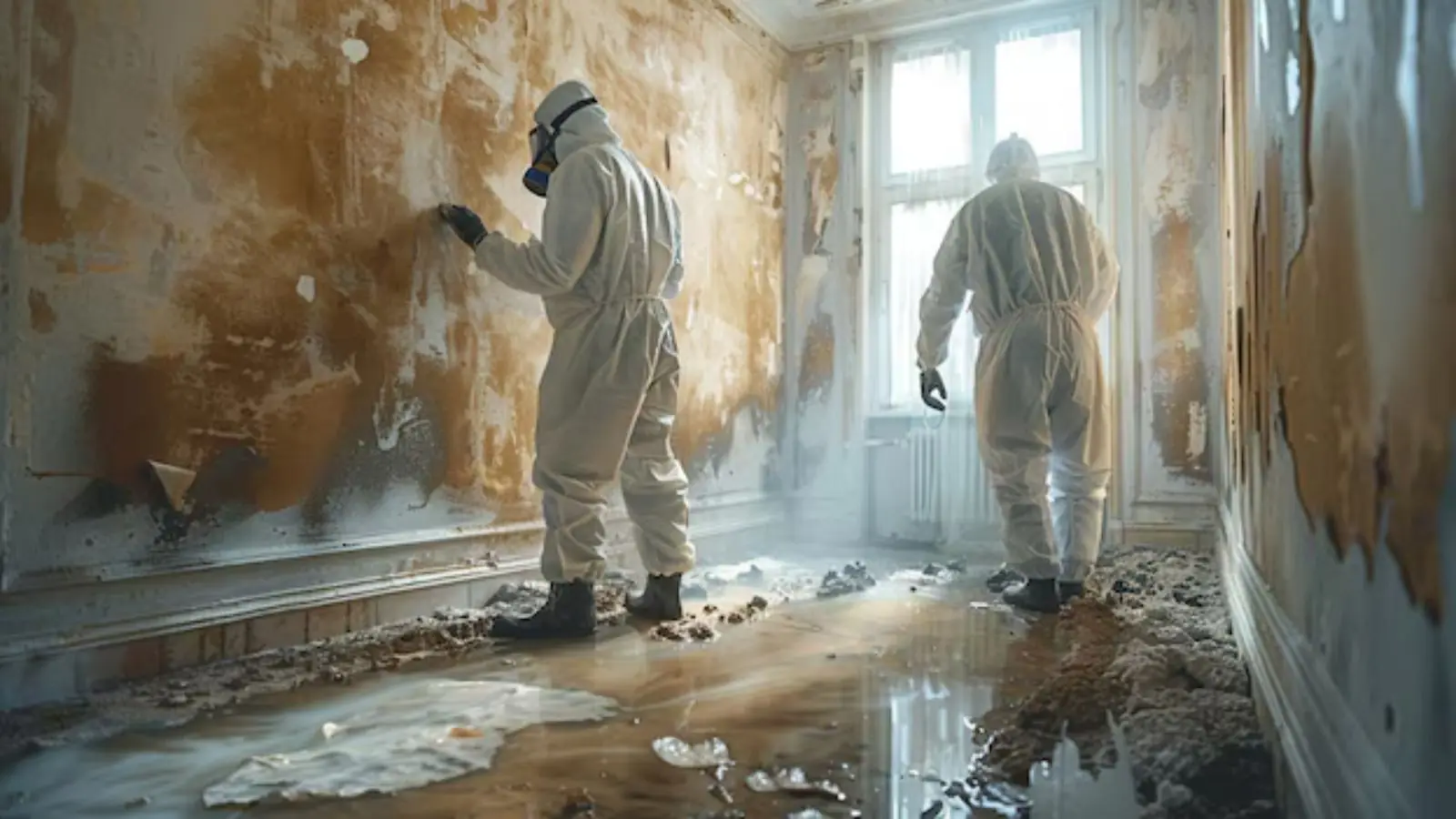
Mold remediation is the controlled removal and cleaning of mold-affected material, done with containment so spores are not spread to clean rooms. The industry reference is ANSI/IICRC S520, and the work only works once the moisture feeding the mold has been found and stopped.
If you are in Glendora and looking at a stain, a smell or a patch of dark growth, the sections below explain what the work involves, who does what, and where a homeowner's judgment ends. Our 24/7 dispatch line takes mold calls too, and it is the same line used for water losses.
A Musty Smell, Dark Spots or a Stain That Keeps Coming Back
Those are the usual ways mold shows up in a house: a closed-in smell in a closet, dark spots in a bathroom corner, or a ceiling stain that fades after painting and reappears. A repeat stain means moisture is still reaching that spot, and paint only hides the surface.
The trade name for the work is mold remediation. A crew finds the moisture source, seals off the area, removes affected material and cleans what can stay. Nothing about it is quick, and nothing about it works if the leak is still active.
Mold Removal and Black Mold Cleanup
People call it black mold when growth looks dark, but color alone does not identify a type. Dark patches can be several kinds of growth, and only lab testing names them. The cleanup method does not depend on the label. It depends on how much material is affected and what that material is.
Small patches on a hard, nonporous surface such as tile can sometimes be cleaned by a homeowner. The EPA treats larger areas differently and suggests consulting an experienced professional. Anything on wallboard, insulation or ceiling tile usually means removal, because mold grows into porous material that cannot be fully cleaned.
The work is source removal first. The crew isolates the area with containment barriers, cuts out affected material and bags it, then cleans the framing and surfaces that remain. Health questions about exposure belong to a physician, not to a contractor.
Mold After Water Damage
Mold needs moisture, and water damage supplies it. The EPA recommends reaching a water loss inside 24 to 48 hours, which it ties to avoiding growth, and wants carpet dried in that window. It also says growth will not always appear after 48 hours, so the figure is a guideline and not a deadline.
If a loss is recent, quick drying through drying the structure right away is the better route, since it removes the moisture before growth takes hold. Once material has been wet longer than 48 hours, or visible growth appears, the EPA points to remediation guidance instead of simple drying.
The leak must be fixed first. Remediating a room while a pipe still drips only invites the same problem back. Ask your plumber to confirm the source is closed before the crew builds containment.
Mold Testing and Inspection
A mold inspection is a visual and instrument survey. The inspector looks for visible growth, reads moisture meters and infrared images to find damp areas behind surfaces, and may take air or surface samples. The result is a report, not a repair.
Independent clearance testing happens after remediation. A third party, with no stake in the cleanup, samples the air or surfaces to see whether the work area looks like normal conditions. A remediation company can describe the process, but the sampler and the lab are separate parties.
Testing cannot promise a result. A report is a snapshot of one day, and no test answers a health question. Check with the state on whether mold work is licensed, and have the tester walk you through the report.
Who Does What: Situation, Action and Responsible Party
| Situation | Typical action | Who does it |
|---|---|---|
| Small patch on tile or a sealed hard surface | Clean with detergent and water, fix the moisture source | Homeowner, or a handyman |
| Stain on drywall ceiling below a bathroom | Find the leak, open the ceiling, remove affected board | Plumber for the leak, then remediation crew |
| Musty smell and no visible growth | Moisture survey and inspection, then a plan | Inspector or the remediation company |
| Large area or growth after a long leak | Containment, negative air, removal and cleaning to S520 | Remediation crew |
| Home sale or lender asks about mold | Inspection, remediation if needed, clearance testing | Inspector, crew and independent sampler |
| Water just arrived, under 48 hours | Extraction and drying before growth begins | Water mitigation crew |
No table replaces a look at your own home. An assessment decides which row you are in.
Ready for a scope for mold remediation?
Call dispatch to talk through the damage. Scope and price are explained before work starts.
How the Remediation Works
The sequence below follows the published S520 approach, and each step answers a specific risk.
Containment
Plastic barriers seal the work area, and zipper doors let crews pass without opening the whole room to the house.
Negative air machines
Machines fitted with HEPA filtration pull air out of the contained area so it flows inward, which helps keep particles from leaking into clean rooms.
Source removal
Affected wallboard, insulation, pad and other porous material is cut out and double-bagged.
Cleaning
Framing and remaining surfaces are HEPA-vacuumed and wiped or sanded, depending on the material.
Drying
Air movers and dehumidifiers bring moisture readings to normal so nothing regrows from dampness.
Verification
The crew checks the work visually and with a moisture meter, and clearance testing by a third party can follow.
What Gets Removed and What Gets Cleaned
Porous materials soak up mold and rarely come clean. Hard materials usually do.
Usually removed
Wallboard, ceiling tiles, insulation, carpet pad and unfinished particleboard with growth in them.
Often cleaned
Wood framing, concrete, tile, metal and glass, using HEPA vacuuming and damp wiping.
Case by case
Hardwood, finished cabinets, upholstered furniture and personal items, depending on how deep the growth goes.
Contents
Items from the work area are moved out or covered before containment goes up.
Common Glendora Scenarios
AC condensate lines are a frequent culprit. When the line clogs, the drain pan overflows into a ceiling, closet or attic, and the stain shows up weeks later as a dark spot. The fix is a cleared drain line, then removal of the soaked material and drying of the cavity.
Closets and bathroom ceilings grow mold for different reasons. A closet on an exterior wall stays cool and still, while a bathroom ceiling collects steam. A working exhaust fan vented outside, and a dry supply line above, address those causes.
- Dark spots in the corner of an exterior closet: check for a leak or condensation on that wall
- A ceiling stain that returns under an upstairs bath: check the toilet flange and supply lines
- A smell near the air handler: check the condensate line and drain pan
Honest Limits
Mold remediation removes growth and the damp material feeding it. It does not stop leaks, and it is not the rebuild stage that replaces the wall afterward. No company can promise growth stays away, because that depends on moisture in the home.
Restoration is also not waterproofing. We do not waterproof foundations or basements, and a restoration crew will not seal exterior walls against future water. If your home has a recurring water entry problem, a waterproofing or drainage contractor is the right call after remediation. For a fresh loss with soaked drywall, tear-out and cleanup comes first.
What Changes the Scope and Price
Mold jobs vary more than almost any other restoration work. These factors set the scope.
Area affected
Square footage of growth and of the damp material around it.
Materials involved
Wallboard and insulation come out. Framing and concrete are cleaned.
Containment and air handling
Larger or higher-risk areas need more barriers and more negative air machines.
Moisture source
An open leak must be repaired first, and the repair can be the largest cost.
Rebuild and testing
Replacing removed materials and any third-party clearance testing are separate scopes.
Mold coverage usually turns on what caused the moisture, and policies differ. A sudden loss may be covered while a slow leak often is not. Read the mold wording in your policy, put it to your insurer, and keep photos and any inspection report.
Want your real number? Call (626) 879-0276 and the scope and price are explained before work starts.
Glendora Notes for Mold Work
The city's permit desk sits at Building and Safety on E. Foothill Blvd. Cutting out and replacing wallboard may be treated differently from a surface cleaning, so settle that question with the desk before work begins.
To check a contractor, the state's Contractors State License Board offers a license lookup at cslb.ca.gov. Neighbors in Covina and other nearby towns use the same line, and calling at night or on a weekend reaches the same 24/7 dispatch.
Frequently asked questions
A musty smell usually means damp material somewhere out of sight. A moisture survey with a meter and an infrared scan can find it. Health questions about the smell belong to a physician.
Some buyers and lenders ask for documentation after remediation. Clearance testing by an independent sampler produces a lab report, which you can hand over. We cannot say what any lender or buyer will accept, so ask them what they require.
Yes, if the water soaks ceiling, attic or closet materials and stays damp. Clearing the drain line stops the water. Wet wallboard or insulation is then removed or dried, depending on how long it stayed wet.
Both have moisture and little airflow. Closets on exterior walls stay cool, and bathroom ceilings collect steam. A vented exhaust fan and a repair of any leak above are the usual first steps.
No. Restoration is not waterproofing. We remove water damage and mold-affected material and dry the structure, but we do not seal foundations or build drainage. A waterproofing contractor handles that.
On a small nonporous surface, a homeowner can clean with detergent. On wallboard or insulation, surface cleaning leaves growth in the material. If the stain returns, moisture is still present.
That depends on the area and the drying time. Take permit questions to the city, and separately check whether the state licenses mold work.
Talk to dispatch
The line is open 24/7. Describe what you see and the next step is explained.