
Standing water gets worse by the hour, so the first call matters. Dispatch answers 24/7. Until a crew is on the way, shut off the main water valve, move valuables up onto counters, keep kids and pets clear of it, and trip the breaker for a soaked room only from a panel on dry floor.
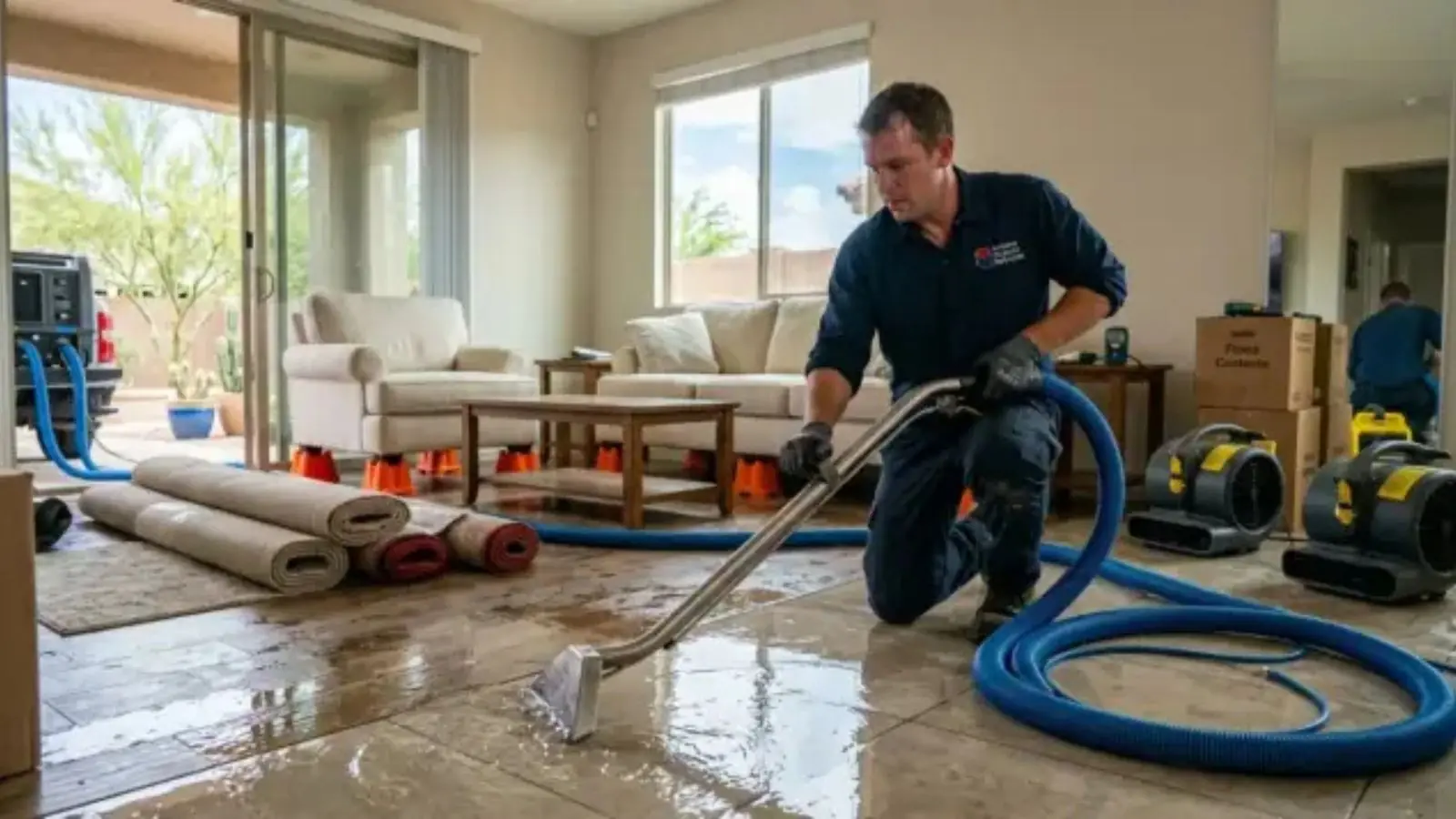
Emergency water removal is the pump-and-extract stage of a water loss: getting the pooled water out of the building with submersible pumps, truck-mounted and portable extraction units, and weighted extractors, before it soaks into wallboard, subfloors and framing.
When Standing Water Is an Emergency
Any water deeper than a damp patch deserves a call. It soaks upward into baseboards and wallboard and works down through seams into the subfloor, so by day two the job has shifted from removal to drying and tear-out.
Call at once if the water is spreading, more than an inch deep, near outlets, or came up a drain or toilet. A 2 a.m. call is handled like a noon call, with same-day dispatch when a crew is open.
The Equipment That Pulls Water Out
Truck-mounted extraction
A vacuum unit on the truck with long hoses run through the front door, for large volumes in flooded rooms.
Portable extraction units
Smaller units carried inside for upstairs rooms and tight hallways.
Submersible pumps
Placed directly in deep water in garages and crawl spaces, pushing it out through a discharge hose.
Weighted extractors
A flat tool with a heavy weight that squeezes water out of carpet fibers and pad into the vacuum.
Moisture meters and thermal cameras
Used once the water is gone to find what is still wet inside walls and under flooring.
Burst Pipe Water Damage
A burst pipe sends gallons per minute into the structure, so the first job is the main water valve. Find it before you need it. It is usually at the front of the house near the street or beside the water heater. Turn it clockwise until it stops, then open a faucet at the lowest point to drain the lines.
Weekdays from 8am until 5pm, the water office at 116 E. Foothill Blvd takes questions. Its web page names no line for nights or weekends, so a Saturday night burst means shutting the valve yourself and calling the restoration line.
Azusa Light & Water supplies part of Glendora instead of the city. Your water bill tells you which utility you have. If the street-side meter shutoff is the only option, the utility is the one to ask, so keep the bill within reach.
Carpet, Hard Floors and Where the Water Went
| Surface | How water is removed | What can go wrong |
|---|---|---|
| Carpet over pad | Weighted extractor, then lifting the carpet edge to extract the pad and subfloor | Pad stays wet if only the top is vacuumed |
| Tile or sheet vinyl | Squeegee and wet vacuum, then edges and grout lines extracted | Water sits under the layer and loosens adhesive |
| Solid hardwood | Surface extraction, then drying mats or panels to pull moisture from boards | Cupping or buckling if left wet |
| Concrete slab | Pumps and wet vacuum, then dehumidification | Moisture lingers in the slab and affects what goes on top |
Burst Pipe Under a Sink
A vanity supply line is a common failure, and the water goes unseen until the cabinet floor swells. Close the shutoff under the sink or the main, empty the cabinet and photograph it before anything is thrown out.
The crew extracts water from the cabinet base and the floor in front, then opens the toe-kick to look behind it. Tile and vinyl seams nearby are checked too.
Crawl Space Water
Nobody lives under the floor, so it is easy to ignore, yet it soaks insulation and raises humidity under the floor. Submersible pumps move it out, then the crew removes wet insulation and checks whether the vapor barrier shifted.
Glendora's foothills sit on the north edge of town, and in 2014 the Colby burn area sent mud and debris down some streets. Runoff that fills a crawl space can carry silt, and silty water is handled with more caution than clean supply water.
Need water removal now? Call the 24/7 line.
Dispatch is open around the clock. Scope and price are explained before work starts.
Stay Out Where Water Meets Electricity
Never wade through water that reaches outlets, appliances or a panel. The main breaker can be thrown only from a dry floor, with dry hands. A gas smell or sparking means walking out and phoning 911 or the gas and electric utility first, then the restoration line.
Which Situation, Which First Move
| Situation | What to do first | What the crew does |
|---|---|---|
| Pipe burst in a wall | Shut off the main, open a low faucet | Extract water, open the wall if needed, set up drying |
| Washer hose or valve break | Close the valve and unplug the washer | Extract, then check the wall and floor below for spread |
| Sewage coming up a drain | Keep everyone out and stop using fixtures | Treat as contaminated water with protective equipment |
Sewage is a different class of problem. For public sewer backups, the county's sewer maintenance district runs an around-the-clock help line.
What Happens After the Water Is Out
Extraction removes the bulk of the water but not the moisture inside materials. The crew then measures walls and subfloors with moisture meters and uses a thermal imaging camera to find hidden damp.
The next stage, the drying stage, uses fans and dehumidifiers. Hauling away wet wallboard, pad or contents falls under the cleanup service. Extraction is the first step, not the repair.
Limits Worth Knowing
Pumping a flooded room does not dry the walls or fix the pipe, because a plumber does that. Water arriving from outside after a storm is a different loss, covered under flood damage work. S500 is the published standard for this work, and any company should be able to say whether its crews follow it.
What Changes the Scope and Price
Extraction quotes follow the volume of water and how hard it is to reach.
Water category
Clean supply water, gray water and sewage each need different handling.
Depth and area
More square footage and deeper water mean more pumping time and more hoses.
Access
A crawl space or an upstairs room takes more labor than a garage floor.
Flooring and materials
Carpet, pad, hardwood and tile each need a different extraction method.
Drying that follows
Days of equipment and the number of rooms affected shape the final scope.
Read your policy and put questions to your agent. Sudden and accidental losses are often covered, slow leaks often are not, and flood or mudflow usually needs its own flood policy. Photograph the water before it is pumped out.
Want your real number? Call (626) 879-0276 and the scope and price are explained before work starts.
Glendora Notes for Water Removal
Ahead of December 2014 storms, county crews emptied foothill debris basins above Glendora, with room for as much as 45,000 cubic yards of rock, mud and sediment to come out. The takeaway for homeowners: runoff can arrive with debris, so after a storm a pump is only part of the cleanup.
People in San Dimas call the same dispatch line. Look your address up on the FEMA flood map before guessing what your policy covers.
Frequently asked questions
We do. Calls at 3 a.m. or on a Sunday reach the same 24/7 line, and a crew is sent the same day when one is available. Arrival times are not promised. Shut off the main valve and stay clear of the water.
Carpet gets a weighted extractor, then the edge is lifted so pad and subfloor can be extracted. Hard floors are squeegeed and vacuumed, and hardwood may get drying mats.
Shut off your own main first. The city water office keeps weekday hours with no after-hours line posted, so the restoration line is the night call. Your bill shows whether the city or Azusa Light & Water serves you.
Yes. Submersible pumps move the water out, then the crew checks insulation, the vapor barrier and floor framing. Wet insulation is typically removed.
Not alone. Mold needs moisture, so extraction comes first and drying second, ideally inside the EPA 24 to 48 hour window.
Stay out and call. Sewage means protective equipment and containment.
Talk to dispatch
The line is open 24/7. Describe what you see and the next step is explained.